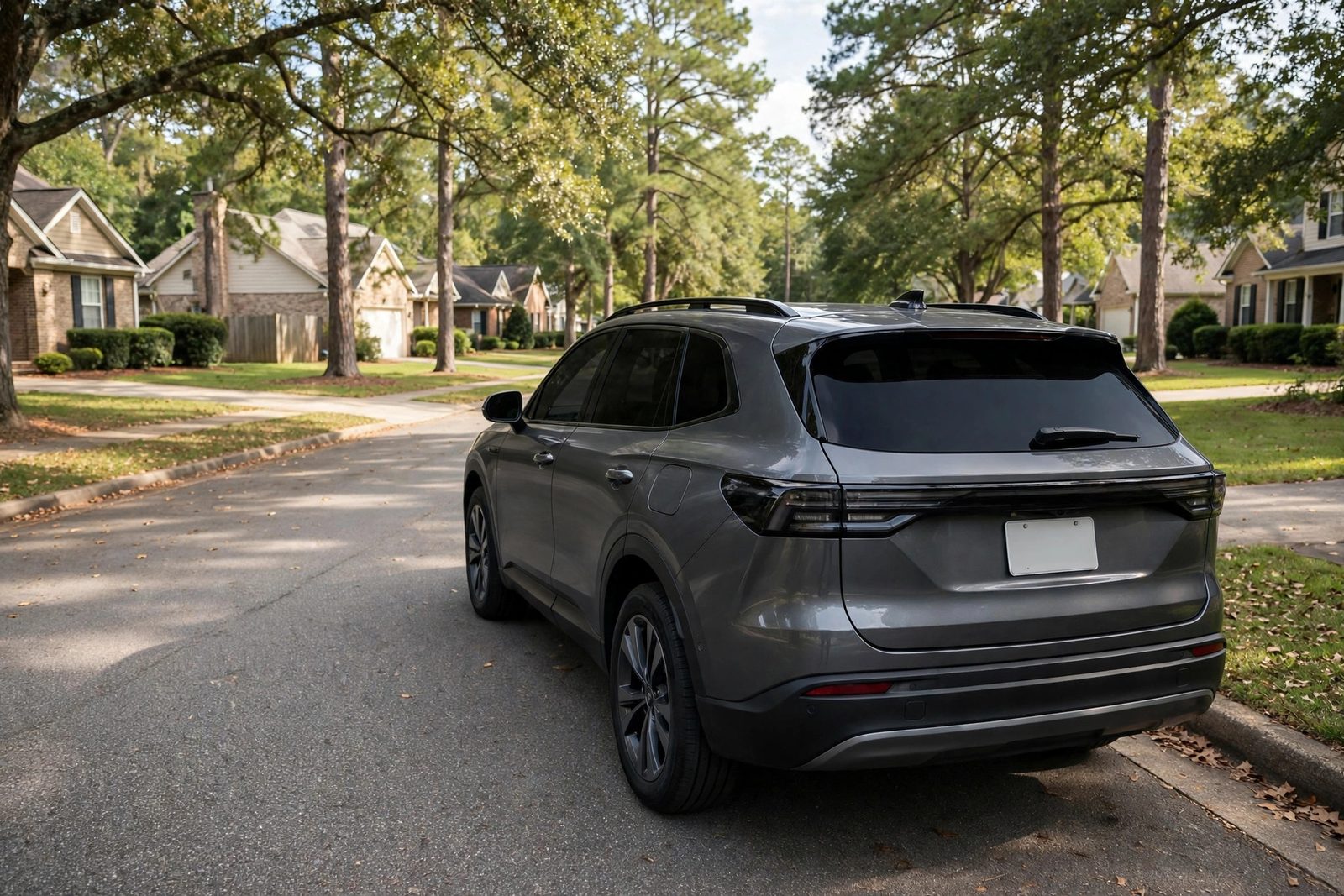
Choosing ceramic window tint vs regular tint for SUVs and trucks is not the sedan decision scaled up. Bigger cabins, sloped rear glass, and factory privacy glass change the math — and Georgia’s multipurpose-vehicle rules change what is legal behind the driver. Here is the honest comparison we give families at the counter.
The short answer: ceramic vs regular tint in Snellville GA
Ceramic rejects far more heat at legal shades: TSER into the low 60s percent, flagship near 71%. Regular dyed film rejects roughly 20–35% and spends its life fading toward purple.
Regular film wins only on day-one price. Across a Snellville ownership cycle — school runs, carpool lines, summer road trips — ceramic pays the difference back in comfort and in never needing replacement.
- Heat: ceramic low-60s % TSER; dyed roughly 20–35%
- UV: ceramic about 99%; dyed varies and drops as it fades
- Color life: ceramic stable for the vehicle’s life; dyed purples in Georgia sun
- Signals: ceramic none; dyed none — metalized is the interference risk
- Price: ceramic $449–$699; dyed $199–$299 for most SUVs and trucks
The sections below explain why big vehicles punish cheap film first, and where regular film is still a rational buy.
Why SUVs and trucks feel hotter than sedans
Volume and glass area: a three-row SUV carries far more air to cool and far more glass to admit heat, including a large, near-flat rear window that acts like a solar collector in driveway parking.
Factory privacy glass deepens the trap. It looks tinted, so owners assume protection exists — but colored glass alone rejects little infrared and limited UV. Kids and dogs in the third row sit behind the least protective glass on the vehicle.
Trucks add a vertical rear window inches behind the cab’s occupants. Afternoon sun through it lands directly on headrests and child seats on westbound Highway 78 commutes.
How regular dyed tint actually works
Dyed film is polyester with a dye layer that absorbs visible light. Darkness is its main tool: the shade you see is roughly the protection you get, and heat rejection stays modest.
Absorbed energy has to go somewhere — much of it radiates inward from the warmed glass, which is why a dark dyed SUV still bakes at a standstill.
The dye layer is also the failure point. Georgia UV breaks dyes down unevenly, shifting the color toward purple and dropping clarity, typically within a few summers on big south- and west-facing glass.
None of this makes dyed film useless: for a work truck on a short ownership horizon, $199–$299 buys real privacy and glare relief. It is a budget tool, honestly labeled.
How ceramic window tint works
Ceramic film rejects infrared with non-metallic nanoparticles instead of relying on darkness. A legal 35% front shade can out-reject a 15% dyed shade — critical, because Georgia fronts must meter at 28% VLT or lighter.
Behind the driver, multipurpose vehicles are exempt from VLT floors, so ceramic can be layered over factory privacy glass for heat control while the glass itself supplies the darkness. We verify classification — including pickups, on the door-jamb label — first.
Ceramic contains no metal, so key fobs, phone key apps, GPS, and TPMS all behave normally. Its color layer is stable: the shade installed is the shade that stays. See the film itself on our ceramic window tint page.
Does regular tint block heat in Snellville Georgia?
Some — roughly a fifth to a third of total solar energy, mostly by absorbing visible light. On a sedan that can feel adequate; on a sun-soaked SUV it is the difference between tint that helps and tint that transforms.
The comparison that matters is TSER at a legal shade, not darkness in a photo. Our ceramic vs carbon comparison shows the same TSER logic one tier down.
If your SUV lives garaged and your trips are short, regular film’s limits may never bother you. If it lives in a driveway off Scenic Highway, they will by July.
Is ceramic window tint better than regular tint in Snellville GA?
For heat, UV, and longevity: yes, decisively. For a short-horizon budget: regular film is defensible. The mistake is paying mid-tier money for dyed film dressed in premium language.
Where ceramic earns it on family vehicles:
- Third-row and cargo-area heat for kids and pets
- Legal front shades that still reject serious infrared
- No purple fade on a vehicle you plan to keep
Where regular film is enough:
- Work trucks on two-to-three-year horizons
- Privacy-first needs on rear glass behind the driver
- Garage-kept vehicles with short summer exposure
- Tight budgets where some film beats none
Either way, the install should end with a meter reading. Our SUV window tinting and truck window tinting pages show how we document both.
Ceramic vs regular tint cost in Snellville GA
October 2026 guide ranges for most SUVs and crew-cab trucks mirror the car bands, with the largest glass toward the top:
By film:
- Dyed: $199–$299
- Carbon (the middle path): $299–$449, color-stable
- Ceramic: $449–$699
- Flagship ceramic: $599–$899; sunroofs add $99–$199
The two-fronts job — matching legal fronts to factory rears — runs $129–$249 in any tier and is the single most common truck ticket we write.
Full tables live on our pricing page. Removal of failed film, when needed, runs $149–$299 and is quoted separately, in writing.
What to watch out for before you tint
SUV and truck owners get pitched two specific fictions: that factory privacy glass already blocks heat, and that darker is automatically cooler. Both collapse the moment TSER enters the conversation.
Watch for these as well:
- Fronts matched “evenly” to dark rears — illegal below 28% metered, whatever the shop says
- Unverified pickup claims — classification gets checked on the door-jamb label, not assumed
- Metalized film on modern trucks — the signal-interference and reflectivity risk is real
- No meter at delivery — on big glass, ask for the reading on the fronts
- Brand-name fog — film by type and TSER, not dealer badges
Georgia’s full 28% / 15% framework is in our Georgia tint law guide — worth five minutes before any big-vehicle install.
When to call a professional
Call when the vehicle has factory privacy glass, a panoramic roof, or a third row that cooks — the film plan for big glass is genuinely different from a sedan’s.
At O2 Window Tinting, 3304 Stone Mountain Hwy, Snellville, we meter factory glass first, then quote dyed, carbon, and ceramic side by side. Rated 4.9 stars across 603 Google reviews.
Open Monday–Friday 9 AM–6 PM, Saturday 9 AM–5 PM, closed Sunday. Call (770) 674-2766 with your model and trim and we will price it before you drive over.
Frequently Asked Questions
Is ceramic tint better than regular tint for an SUV?
For heat, yes. Ceramic reaches TSER in the low 60s percent; dyed 'regular' film manages roughly 20–35% and fades purple. On a large SUV cabin the difference is felt within minutes of driving. Regular film only wins on upfront price.
Does factory privacy glass on my truck block heat and UV?
Very little. Factory privacy glass is colored glass, not film — it darkens for privacy but provides minimal heat rejection and UV protection. Adding ceramic film over it is legal behind the driver on multipurpose vehicles and is where the real comfort gain lives.
How dark can I tint my SUV or truck in Georgia?
Front side windows must meter at 28% VLT or lighter on every vehicle. Behind the driver, multipurpose vehicles are exempt from VLT floors, so rear windows can go dark. We verify pickup classification on the door-jamb label before installing darker rear film.
How much does it cost to tint an SUV or truck in Snellville?
October 2026 guide ranges: most SUVs and crew-cab trucks land in the same bands as cars — carbon $299–$449, ceramic $449–$699, flagship $599–$899 — with large glass toward the top. Two front windows alone run $129–$249.
Will ceramic film interfere with my key fob or phone?
No. Ceramic film has no metal content, so key fobs, phones, GPS, and tire-pressure systems work normally. Metalized films are the ones that can interfere, which is why we do not recommend them for modern trucks and SUVs.
Get help with window tinting in Snellville
Start with SUV tinting or truck tinting, compare numbers on the pricing page, or call O2 Window Tinting at (770) 674-2766.
Bring the vehicle by and we will put a meter and a heat lamp on the decision — samples on your own glass settle this comparison faster than any chart.