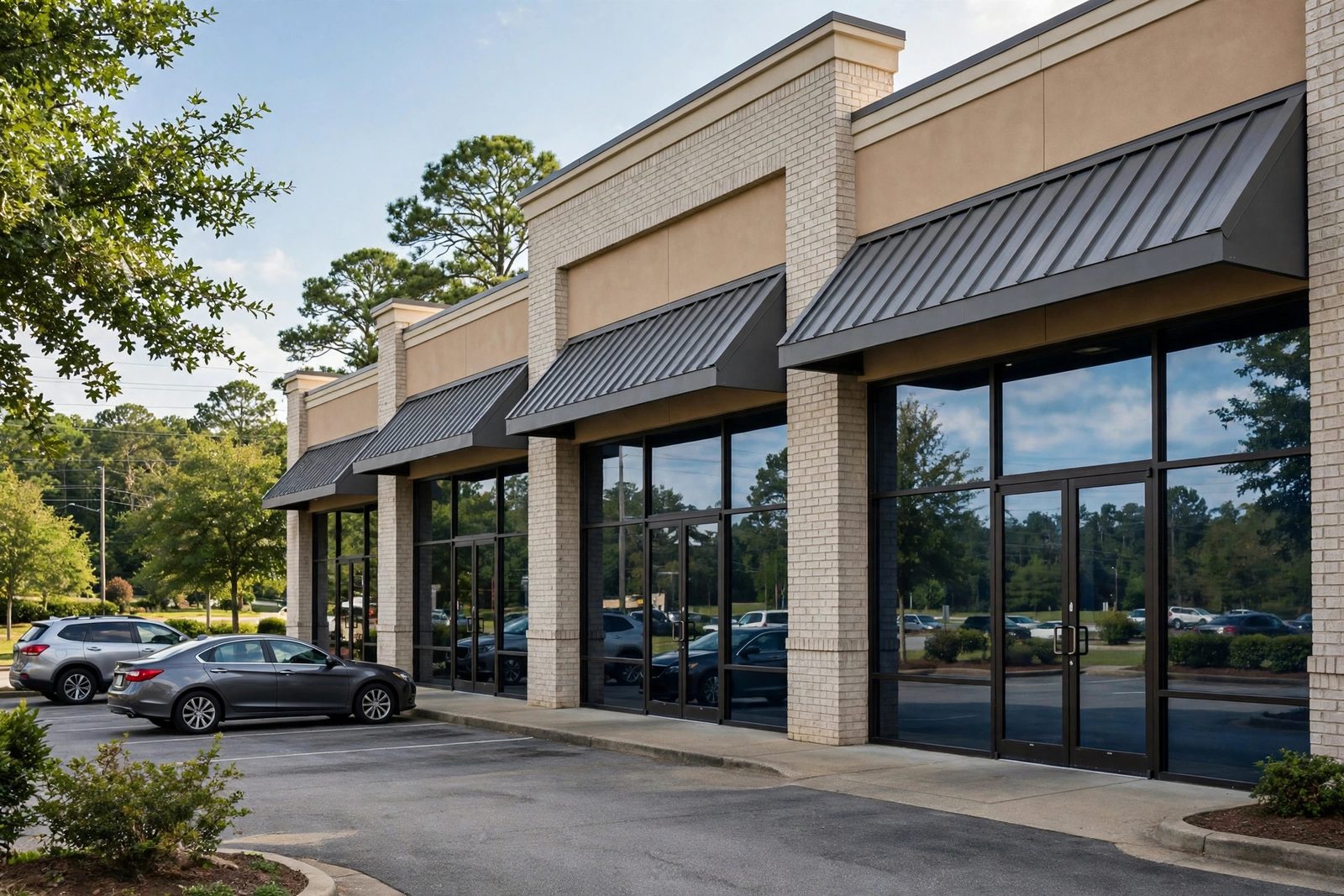
Window tinting for Snellville storefronts solves three problems with one install: glare that washes out displays and screens, solar heat that the AC fights all afternoon, and UV that quietly fades the merchandise closest to the glass. This guide covers film choices, October 2026 guide pricing, and the mistakes to avoid on Highway 78 glass.
Why Snellville storefronts overheat and glare out
Retail glass is designed to invite the sun in — floor-to-ceiling panes, minimal shading, and west or south exposures along the Highway 78 and Scenic Highway corridors. By 3 PM the storefront is admitting more heat than the rooftop unit was sized to reject.
Glare follows the same geometry. Low afternoon sun strikes at display height: point-of-sale screens wash out, customers squint past window merchandise, and staff migrate away from the front of the store — the most valuable floor space you rent.
The comfort gradient is measurable in steps: cool at the back wall, warm at the glass. Employees feel it, customers shorten visits because of it, and the thermostat — usually near the register, near the glass — calls for cooling the whole building to fix one elevation.
Blinds and shades are the usual first response, and they surrender the storefront’s purpose: an inviting, visible interior. Film is the response that keeps the glass a window instead of a wall. Our storefront tinting service starts from that principle.
How does window tinting reduce storefront cooling costs in Snellville GA?
Film rejects a large share of solar energy at the pane — better films reject total solar energy in ranges that transform the afternoon load. Heat that never enters never bills you for removal, and the AC cycles against a smaller enemy during peak-rate hours.
The Department of Energy’s guidance is blunt about windows’ role in building energy: heat gain and loss through windows accounts for a major share of heating and cooling energy. On an all-glass elevation, film is not a cosmetic upgrade; it is the largest single efficiency lever available without construction.
Where the savings concentrate:
- Afternoon peak hours — the solar maximum meets the rate maximum
- West and south elevations — hours of direct, low-angle sun
- Single-pane and older storefront systems — the least efficient glass gains the most
- Spaces with window-line seating or displays — comfort recovered where revenue sits
Set the expectation honestly: film reduces cooling load at the glass; it does not repair an undersized unit or failed ductwork. Owners consistently report the comfort change first and the bill change right behind it.
Restaurants add a wrinkle: window seats are premium seats, and a table nobody will sit at after 4 PM is lost covers nightly. Film returns those tables to service — see commercial window tinting for dining and clinic applications.
What is the best storefront window tint in Snellville?
It depends which problem is costing you most — heat, glare, fading, or vandalism. The four working categories:
By problem:
Solar control film — the default
Balanced heat and glare rejection for general retail. Ceramic and quality solar films keep interiors naturally lit and product colors true, which rules out the dark, heavy tints that make shops look closed.
Dual-reflective film — privacy plus performance
More reflective outside, clearer inside: daytime privacy for clinics, offices, and service businesses, with strong heat numbers. The exterior look is pronounced, so we sample it on your glass before committing an elevation.
Security film — the hold-together layer
Thicker film that holds shattered glass in its frame, delaying entry and containing storm or impact debris. It is not bulletproof and we will never sell it as such — it buys time and keeps glass off your merchandise and customers.
Anti-graffiti film — the sacrificial skin
A clear, replaceable layer that takes the etching, scratching, and paint so the glass beneath does not. For street-facing panes with any vandalism history, it converts a reglazing bill into a film swap.
Many Highway 78 stores combine them: solar film on the sunny elevations, anti-graffiti at street level, security film where after-hours risk concentrates. One site visit sorts the map.
How much does storefront window tint cost near me in Snellville GA?
October 2026 guide ranges, installed, per square foot of glass:
By film family:
- Commercial solar film: $6–$12 per sq ft
- Security film: $7–$15 per sq ft
- Anti-graffiti film: quoted per pane after measurement
- Failed-film removal: inspected and quoted before replacement
Most single-storefront installs complete in a day, scheduled around your hours — early mornings and closed days are routine. Larger elevations phase by section so the business never closes for film.
Compare quotes on the named film and the per-square-foot rate, never on a lump “storefront special.” The full context is on our pricing page.
If your current film is peeling, budget the replacement conversation honestly — our post on why office tint peels explains the causes your new spec must avoid repeating.
Glare, fading, and your merchandise
Glare is a revenue problem disguised as a comfort problem. Customers do not announce that the light drove them out; they simply browse less near the glass. Staff assigned to window registers and host stands absorb the worst of it daily.
Fading is the slow invoice: UV exposure bleaches flooring, fabrics, packaging, and artwork in a visible tide line that moves with the seasons. Quality film cuts UV by about 99%, which is why museums and galleries treat film as collections care, not decoration.
We see the pattern constantly in Snellville: the display that sells from the back of the store and dies at the window, the menu board nobody can read at lunch rush, the clinic waiting chairs arranged everywhere except the sunny wall.
Film fixes the geometry without surrendering the glass. Displays stay lit but readable, window seats return to service, and the merchandise nearest the pane stops aging in fast-forward.
What to watch out for before you sign a tint contract
Four checks before any commercial signature:
- The film is named — type, TSER, reflectance — on the quote itself
- Pricing is per square foot with measured glass, not a lump sum
- Glass compatibility is confirmed for your storefront system
- Your cleaning crew gets ammonia-free instructions in writing
Add a fifth for leased spaces: confirm your landlord’s glass rules before install day. Film is removable, but permission is cheaper than forgiveness in a commercial lease.
When to call a professional
Call when afternoon sun dictates how your floor gets used, when fading reaches merchandise you care about, or when one vandalism incident would cost more than the film that prevents its damage.
At O2 Window Tinting, 3304 Stone Mountain Hwy, Snellville — on the corridor itself — we assess storefronts with the meter and the spec sheet, and quote in writing. Rated 4.9 stars across 603 Google reviews.
Open Monday–Friday 9 AM–6 PM, Saturday 9 AM–5 PM, closed Sunday. Call (770) 674-2766 to schedule a site visit around your business hours.
Frequently Asked Questions
How does window tinting reduce storefront cooling costs in Snellville GA?
Film rejects solar energy at the glass, so less heat enters and the AC runs shorter cycles during the brutal afternoon hours. The Department of Energy notes windows drive a large share of building heating and cooling energy — on an all-glass storefront, that share is the business's biggest lever.
What is the best storefront window tint in Snellville?
For most Highway 78 storefronts, a dual-reflective or ceramic solar film: strong heat and glare control facing out, a clearer view and natural product color inside. Where merchandise fading dominates, prioritize the highest UV and TSER figures; where street presence matters, keep exterior reflectance tasteful.
How much does storefront window tint cost near me in Snellville GA?
October 2026 guide ranges: commercial solar film $6–$12 per square foot installed; security film $7–$15 where hold-together protection is the goal. Anti-graffiti film is quoted per pane after measurement. Written per-square-foot quotes with the film named are the only safe comparison.
Does commercial window tint reduce glare for customers and staff?
Yes — glare is visible light plus angle, and even moderate films cut the washout that blinds point-of-sale screens and drives customers away from window displays. Restaurants and clinics on Scenic Highway usually feel this benefit before they feel the cooling one.
What is anti-graffiti film and does my storefront need it?
It is a sacrificial clear film over the glass: tagging, scratching, and etching damage the film, which peels away and is replaced in minutes instead of reglazing the pane. Storefronts with street-facing glass and any history of vandalism recover its cost the first incident it absorbs.
Get help with window tinting in Snellville
Start with storefront window tinting and commercial tinting, or call O2 Window Tinting at (770) 674-2766 — tell us your corridor and your worst hour of sun, and we will spec from there.